隐角竹鼓
Discover the 隐角竹鼓, a classic Yixing pottery design with unique characteristics
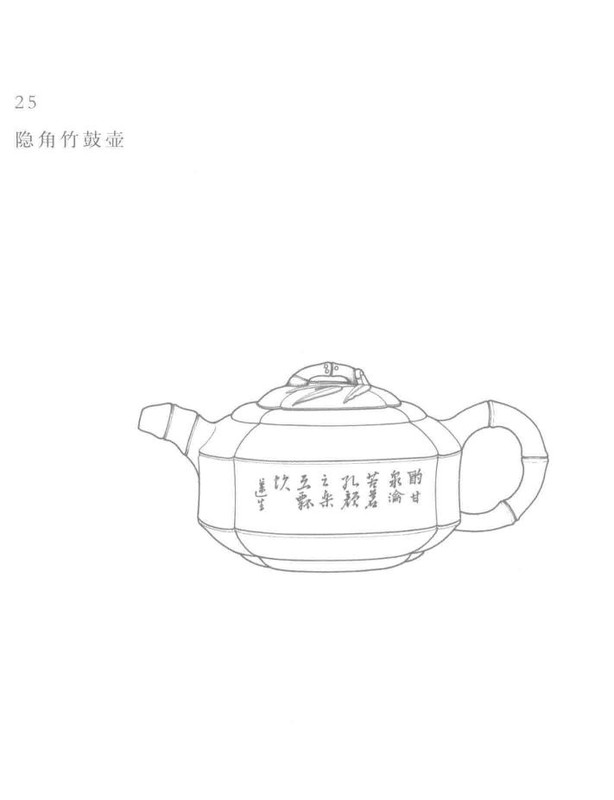
The Hidden Corner Bamboo Drum: A Masterpiece of 1940s Yixing Craftsmanship
The 隐角竹鼓 (Yǐn Jiǎo Zhú Gǔ), or “Hidden Corner Bamboo Drum” teapot, represents one of the most intriguing geometric designs to emerge from Yixing pottery workshops in the early 1940s. This hexagonal masterpiece combines the structural elegance of angular design with the organic inspiration of bamboo, creating a vessel that challenges our expectations of what a teapot can be.
Unlike the flowing curves that dominate much of Yixing’s classical repertoire, the Hidden Corner Bamboo Drum embraces sharp lines and defined edges—yet does so with such subtlety that the “hidden corners” of its name become apparent only upon close examination. This is not a pot that announces itself loudly; rather, it rewards patient observation and thoughtful use.
The Ziyi Xuan Workshop Legacy
The specific example documented from the early 1940s bears two significant seals that tell us much about its provenance. The lid carries the seal “瘦萍” (Shòu Píng), while the base is marked “自怡轩” (Zìyí Xuān, meaning “Self-Contentment Studio”). These markings place this pot within a fascinating period of Yixing history—a time when traditional craftsmanship persisted despite the tumultuous political and social changes sweeping through China.
The Ziyi Xuan workshop name suggests a philosophy of personal satisfaction and inner peace, values that seem particularly poignant given the era of its creation. The early 1940s were marked by wartime hardship, yet Yixing potters continued their meticulous work, perhaps finding in their craft the very “self-contentment” their studio name proclaimed. The presence of Shou Ping’s seal indicates the involvement of a skilled artisan whose work was deemed worthy of individual recognition—a practice that speaks to the pot’s quality and the workshop’s standards.
Decoding the Hexagonal Form
The term “bamboo drum” in this pot’s name refers to its fundamental shape: a hexagonal body that evokes the segmented structure of bamboo stalks and the cylindrical form of traditional Chinese drums. But what makes this design truly distinctive is the “hidden corner” (隐角) aspect—the way the six sides meet at angles that are softened and refined, creating edges that catch the light without appearing harsh or aggressive.
This geometric approach serves multiple purposes. First, it provides a larger surface area for heat retention compared to a round pot of similar volume, allowing for more even temperature distribution during brewing. The flat sides also offer natural resting points for the fingers when pouring, giving the user greater control and confidence in handling.
The hexagonal cross-section creates six distinct faces, each a canvas that can showcase the clay’s natural beauty. As the pot seasons with use, tea oils will accumulate differently on the flat surfaces versus the corners, creating a patina that emphasizes the geometric structure over time. This aging process becomes part of the pot’s visual story, with each face developing its own character while maintaining the overall harmony of the design.
Clay, Color, and Tactile Presence
While the specific clay body used for this early 1940s example isn’t detailed in the documentation, Hidden Corner Bamboo Drum pots were traditionally crafted from Yixing’s prized zisha (purple sand) clay, often in the zhuni (vermillion clay) or duanni (yellow clay) varieties. The choice of clay would have been deliberate, selected to complement both the geometric precision of the form and the intended tea applications.
The angular design demands exceptional skill in construction. Unlike round pots that can be thrown on a wheel or shaped with relative ease, hexagonal forms require precise slab construction or careful paddling techniques. Each of the six sides must be perfectly flat and uniform, with corners meeting at exact angles. Any deviation becomes immediately apparent, making this form unforgiving of imperfection.
The surface treatment of these pots typically maintains the natural texture of the clay, allowing the material’s inherent beauty to speak for itself. The flat faces might show subtle tool marks from the shaping process—not flaws, but rather evidence of the human hand at work, connecting the user to the maker across decades.
The Art of Bamboo-Inspired Design
Bamboo holds profound significance in Chinese culture, symbolizing resilience, flexibility, and integrity. The plant’s segmented structure—with its hollow internals and strong exterior—has inspired countless artistic interpretations. In the Hidden Corner Bamboo Drum, this inspiration manifests not through literal representation but through structural echo.
The hexagonal form suggests bamboo’s natural geometry without mimicking it directly. Real bamboo stalks are cylindrical, but when viewed in cross-section, they reveal a complex internal structure with multiple chambers. The six-sided teapot form captures something of this geometric complexity while remaining entirely functional as a brewing vessel.
The “drum” aspect of the name adds another layer of cultural resonance. Traditional Chinese drums often featured taut skins stretched over cylindrical or barrel-shaped bodies. The Hidden Corner Bamboo Drum’s proportions—typically with height roughly equal to width—echo these percussion instruments, creating a sense of contained energy and potential resonance. When you pour water into this pot, you’re not just filling a vessel; you’re preparing an instrument for the symphony of tea brewing.
Tea Pairing: Finding the Perfect Match
The Hidden Corner Bamboo Drum’s geometric design and typically medium-to-small capacity make it particularly well-suited for certain categories of tea. Understanding these pairings requires considering both the pot’s physical properties and its aesthetic character.
Oolong teas, particularly those from Wuyi Mountain or Anxi, find an ideal home in this pot. The hexagonal form’s efficient heat retention supports the multiple short infusions that oolong demands, while the pot’s size (typically 150-250ml) matches perfectly with gongfu brewing sessions. The angular design seems to complement oolong’s own complexity—teas that reveal different facets with each infusion, much as the pot reveals different faces from different viewing angles.
Aged white teas also pair beautifully with this design. The pot’s heat retention helps coax out the deep, mellow flavors that develop in white tea over years of storage. The geometric precision of the form provides an interesting counterpoint to the organic, unpredictable nature of tea aging—a dialogue between human intention and natural process.
For raw puerh (sheng cha), especially younger vintages with pronounced astringency, the Hidden Corner Bamboo Drum offers advantages. The clay’s porosity helps soften harsh edges while the pot’s shape promotes even extraction. The flat sides create subtle turbulence patterns as water enters, ensuring thorough leaf saturation without over-agitation.
I would generally avoid using this pot for delicate green teas or lightly oxidized oolongs, as the heat retention might be too aggressive for teas that prefer cooler brewing temperatures. Similarly, heavily roasted teas might not benefit from the additional heat retention, though this depends on personal preference and the specific clay body used.
Brewing Technique: Working with Geometry
Using a Hidden Corner Bamboo Drum requires slight adjustments to standard gongfu technique, adaptations that honor the pot’s unique geometry.
Water pouring benefits from awareness of the hexagonal structure. Rather than pouring directly onto the leaves in a circular motion (as you might with a round pot), consider directing the water stream along one of the flat sides, allowing it to cascade down and across the leaves more gently. This approach takes advantage of the geometric form to create a more controlled water flow.
Temperature management becomes more predictable with this design. The flat sides radiate heat more efficiently than curved surfaces, meaning the pot will cool slightly faster between infusions than a round pot of similar volume. This can be advantageous for teas that benefit from gradually decreasing temperatures across multiple steeps.
Pouring technique should account for the angular grip points. The hexagonal body provides natural finger positions that differ from round pots. Many users find they can achieve more precise control by placing fingers along the flat sides rather than wrapping around a curve. This can lead to more confident, steady pours—particularly important when working with expensive or precious teas.
Seasoning the pot follows standard Yixing protocols, but pay attention to how the patina develops across the six faces. Some users deliberately rotate which side faces forward during storage, ensuring even exposure and aging. Others embrace the uneven development, allowing the pot to record its own history of use.
The 1940s Context: Craft in Wartime
Understanding this pot’s early 1940s origins adds poignant depth to its appreciation. This was a period of extraordinary hardship in China, with the Second Sino-Japanese War devastating much of the country. Yixing itself, located in Jiangsu Province, experienced occupation and disruption.
Yet pottery production continued, albeit under difficult circumstances. The fact that workshops like Ziyi Xuan maintained their standards and continued producing refined pieces like the Hidden Corner Bamboo Drum speaks to the resilience of craft traditions. These pots weren’t just functional objects; they represented cultural continuity, a assertion that beauty and refinement could persist even in dark times.
The “Self-Contentment Studio” name takes on additional meaning in this context. Perhaps it reflected a deliberate turning inward, finding satisfaction in the work itself rather than in external circumstances. The pot becomes a vessel not just for tea, but for a particular philosophy of endurance and inner peace.
Collecting and Authenticity Considerations
For collectors interested in Hidden Corner Bamboo Drum pots, several factors warrant attention. Authentic examples from the 1940s, like the documented Ziyi Xuan piece, are increasingly rare and valuable. The presence of clear, well-executed seals is crucial for authentication, though seal marks alone don’t guarantee authenticity.
The quality of construction provides important clues. Genuine examples will show precise geometric execution—corners that meet cleanly, sides that are truly flat and uniform, and overall proportions that feel balanced. The clay body should show appropriate aging characteristics for its purported age, with a patina that develops naturally from use rather than artificial treatment.
Modern reproductions of this classic design exist, and many are excellent pots in their own right. Contemporary Yixing masters continue to create Hidden Corner Bamboo Drum pots, sometimes adding their own innovations while respecting the traditional form. These new pieces offer accessibility to a classic design without the premium prices commanded by vintage examples.
Living with a Hidden Corner Bamboo Drum
Owning and using one of these pots becomes a daily practice in appreciating geometric beauty. The hexagonal form catches light differently throughout the day, creating subtle plays of shadow and highlight that round pots cannot achieve. As you prepare tea, the pot becomes a small meditation on the relationship between human design and natural materials.
The angular form also influences the ritual of tea preparation. There’s something particularly satisfying about the way this pot sits on a tea tray, its defined edges creating clear spatial relationships with other tea tools. It brings a sense of order and intentionality to the tea session.
Over months and years of use, you’ll notice how the pot develops character. The flat faces will show tea staining differently than the corners. The areas where your fingers naturally rest will develop a subtle polish. The pot becomes a record of countless tea sessions, each leaving its microscopic trace.
Conclusion: Geometry Meets Tradition
The Hidden Corner Bamboo Drum stands as a testament to Yixing pottery’s capacity for innovation within tradition. It takes the ancient craft of teapot making and applies geometric principles that create something both familiar and surprising. The hexagonal form isn’t merely decorative; it’s a functional choice that affects heat retention, handling, and the brewing process itself.
The early 1940s example from Ziyi Xuan workshop, marked with Shou Ping’s seal, represents this design at a particular moment in history—a moment when craft persisted despite chaos, when artisans continued pursuing excellence even as the world around them fractured. Using such a pot, or even a contemporary interpretation of this classic form, connects us to that legacy of resilience and dedication.
Whether you’re drawn to the Hidden Corner Bamboo Drum for its aesthetic appeal, its functional advantages, or its historical significance, this design offers rewards that deepen with time and use. It’s a pot that asks you to slow down, to notice details, to appreciate the dialogue between straight lines and organic materials. In our curved, flowing world, there’s something refreshing about the honest angularity of this design—a reminder that beauty can take many forms, and that sometimes the most interesting paths are the ones that don’t follow the expected curves.
