平盖莲子壶
Flat-Lid Lotus Seed The lid fits tightly without gaps. The spout is elongated and graceful. This teapot lowers the center of gravity based on trad
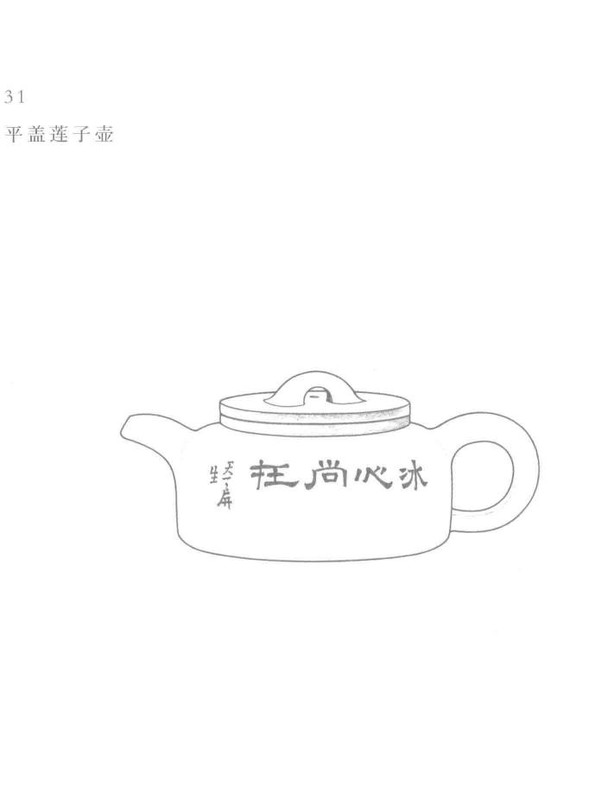
The Flat-Lid Lotus Seed Teapot: A Masterpiece of Balanced Elegance
The 平盖莲子壶 (Píng Gài Lián Zǐ Hú), or Flat-Lid Lotus Seed teapot, represents one of the most refined expressions of classical Yixing pottery design. Named for its distinctive flat lid and the lotus seed’s characteristic rounded form, this teapot achieves something remarkable: it balances visual simplicity with sophisticated engineering, creating a vessel that feels both ancient and surprisingly modern.
What sets the Lotus Seed apart from other classical Yixing designs is its masterful manipulation of visual weight and proportion. While many traditional teapots emphasize vertical elegance or horizontal stability, the Lotus Seed does both simultaneously—lowering its center of gravity while maintaining an upright, dignified posture. The result is a teapot that appears grounded yet graceful, substantial yet refined.
A Study in Curves and Balance
The genius of the Flat-Lid Lotus Seed lies in its deceptively simple construction. At first glance, you see a rounded teapot with clean lines—nothing extraordinary. But spend time with this design, and you begin to notice the subtle sophistication in every curve and angle.
The body itself embodies a fascinating paradox: though composed entirely of curved lines, it suggests squareness. This “roundness suggesting squareness” creates what potters call “stability without stagnation”—the pot feels solid and grounded, yet there’s nothing heavy or static about it. The curves are powerful and clean, each line crisp and deliberate. This is not the work of someone sketching freehand; this is calculated geometry disguised as organic form.
The flat lid sits naturally atop the body with what the source material describes as a “compressed mouth”—meaning the opening is slightly narrowed, creating a tight seal without gaps. This isn’t merely aesthetic; a well-fitted lid is crucial for proper tea brewing, maintaining temperature and allowing the tea leaves to expand fully without losing precious aromatics. The bridge-shaped knob crowning the lid is proportionally scaled down to harmonize with the body, never dominating the visual composition.
Perhaps most striking is how the teapot handles the relationship between its three projecting elements: spout, handle, and knob. The tubular spout tilts slightly upward—not dramatically, but just enough to create visual momentum. Meanwhile, the ring-shaped handle’s center of gravity sinks slightly lower than you might expect. This creates what the artisan intended: a balanced correspondence between front and back, a visual conversation between the forward-reaching spout and the grounding presence of the handle.
The curved handle itself “follows the body’s momentum, with energy flowing through to the spout.” This isn’t poetic exaggeration—it’s a description of how well-designed teapots guide the eye and hand. When you pour from a Lotus Seed pot, the handle’s curve naturally positions your wrist at the optimal angle, while the spout’s placement ensures a smooth, controlled pour.
The European Aesthetic in Chinese Clay
One of the most intriguing aspects of the Flat-Lid Lotus Seed is what the source material describes as its “distinctly European aesthetic.” This might seem contradictory for a classical Chinese teapot, but it speaks to a fascinating period of cultural exchange in Yixing pottery history.
During the 1940s—the era associated with certain examples of this design—Chinese potters were increasingly exposed to Western design principles through trade, missionary activity, and the cosmopolitan atmosphere of treaty ports. Some artisans began incorporating elements of Western symmetry, proportion, and restraint into traditional forms. The Lotus Seed’s emphasis on geometric harmony, its almost architectural approach to balance, and its unadorned surfaces reflect this cross-cultural dialogue.
Yet the pot remains unmistakably Chinese in its philosophy. The principle that “great skill appears effortless” (大巧若拙) is fundamental to Chinese aesthetics, and the Lotus Seed embodies this perfectly. There’s no showiness here, no decorative flourishes demanding attention. Instead, the pot achieves what Chinese connoisseurs call “honest simplicity”—a purity of form that reveals the maker’s mastery precisely through what isn’t there.
The lustrous patina that develops on these pots over time adds another layer of beauty. Yixing clay is porous and absorbs tea oils with each brewing, gradually building up a sheen that cannot be replicated artificially. A well-used Lotus Seed pot becomes a record of every tea session, its surface telling the story of years of careful brewing.
Clay, Color, and Character
While the source material doesn’t specify the exact clay type used for this particular Lotus Seed example, classical designs of this era were typically crafted from zhuni (朱泥, red clay) or duanni (段泥, yellow clay). The choice of clay profoundly affects both the pot’s appearance and its brewing characteristics.
Zhuni, with its fine particle size and high iron content, fires to a rich reddish-brown and produces a very dense, smooth surface. Pots made from zhuni have excellent heat retention and are particularly prized for oolong teas. The clay’s density means it develops patina more slowly but more evenly, creating that coveted lustrous finish over time.
Duanni, lighter in color and slightly more porous, offers different advantages. Its higher kaolin content gives it a warmer, more muted tone—ranging from pale yellow to light brown. Duanni pots are more forgiving for beginners, as the clay’s porosity helps regulate temperature and can soften harsh notes in tea.
The “dignified form” mentioned in the source material suggests this particular example may have been crafted from a higher-fired clay, giving it that substantial, authoritative presence. The compressed mouth and tight-fitting lid would have required clay with excellent plasticity and minimal shrinkage during firing—characteristics of premium Yixing clays.
Historical Context and Craftsmanship
The Lotus Seed design belongs to what collectors call the “classical period” of Yixing pottery, though examples have been produced across several centuries. The 1940s examples mentioned in the source material represent a particularly interesting moment in Yixing history.
This was a period of both continuity and change. Traditional workshops continued producing classical designs using time-honored techniques, but the political and social upheaval of the era meant that many master potters were working in difficult circumstances. Paradoxically, this sometimes led to exceptional work—artisans focused on perfecting traditional forms rather than experimenting with new designs.
The seal inscriptions mentioned in the source material (瘦萍 and 自怡轩) would have identified either the maker or the studio. These seals are crucial for authentication and can significantly affect a pot’s value among collectors. The name 瘦萍 (Shòu Píng, “Slender Duckweed”) has a poetic quality typical of artisan names, while 自怡轩 (Zì Yí Xuān, “Self-Contentment Studio”) suggests a workshop name emphasizing the meditative, self-cultivating aspects of tea culture.
The Art of Tea Pairing
The Flat-Lid Lotus Seed’s design characteristics make it particularly well-suited for certain types of tea. Understanding these pairings helps you appreciate why form follows function in Yixing pottery.
Oolong Teas: This is where the Lotus Seed truly excels. The pot’s rounded body provides ample room for oolong leaves to unfurl completely—crucial for these semi-oxidized teas that can expand to several times their dry volume. The slightly upward-tilting spout ensures you can pour out every drop without disturbing the leaves, while the tight-fitting lid maintains the consistent temperature oolongs need for proper extraction.
Traditional Taiwanese high-mountain oolongs, with their floral complexity and creamy texture, pair beautifully with the Lotus Seed’s balanced proportions. The pot’s shape encourages even heat distribution, bringing out the tea’s subtle aromatics without emphasizing any single note. Similarly, Wuyi rock oolongs—with their mineral depth and roasted character—benefit from the pot’s ability to maintain steady heat while allowing the tea to breathe.
Aged White Teas: The Lotus Seed’s generous body and excellent heat retention make it ideal for aged white teas like aged Bai Mudan or Shou Mei. These teas require sustained heat to fully release their complex, mellow flavors. The pot’s design ensures the water temperature remains stable throughout multiple infusions, allowing the tea to gradually reveal its character.
Red Teas (Black Teas): Chinese red teas, particularly Yunnan Dian Hong or Fujian Zheng Shan Xiao Zhong, work wonderfully in a Lotus Seed pot. The rounded body allows the larger leaves to expand freely, while the pot’s balanced proportions prevent over-extraction. The result is a smooth, sweet cup that highlights the tea’s natural maltiness without astringency.
What to Avoid: The Lotus Seed is less ideal for delicate green teas or white teas that require lower temperatures. The pot’s heat retention, an asset for oolongs and red teas, can scorch tender green tea leaves. Similarly, the generous body size means you’ll want at least 4-5 grams of tea for proper brewing—making it impractical for expensive teas you want to brew in tiny quantities.
Brewing Techniques and Practical Wisdom
Using a Flat-Lid Lotus Seed pot properly requires understanding its specific characteristics and adjusting your technique accordingly.
Seasoning Your Pot: Before first use, the pot needs proper seasoning. Place it in a pot of clean water with some tea leaves (use the type you plan to brew regularly) and bring to a gentle simmer for 30 minutes. This opens the clay’s pores and removes any residual kiln dust. Let it cool naturally in the water, then rinse and air dry completely. Never use soap or detergents—the porous clay will absorb them.
Water Temperature: The Lotus Seed’s excellent heat retention means you can use water slightly below boiling (around 90-95°C/194-203°F) for most oolongs. The pot will maintain sufficient heat for proper extraction. For red teas, full boiling water works well, as the pot’s design prevents over-extraction even at higher temperatures.
Tea-to-Water Ratio: The rounded body typically holds 150-200ml when filled to the appropriate level (about 80% full to allow for leaf expansion). Use approximately 5-7 grams of tea for this volume—adjust based on the tea’s density and your taste preferences. The pot’s shape means leaves settle naturally at the bottom, making it easy to pour clean liquor without leaf fragments.
Pouring Technique: The slightly upward-tilting spout requires a confident pour. Tip the pot decisively—hesitant pouring can cause dripping. The well-designed spout should cut off cleanly when you return the pot to upright. If you experience dripping, the pot may need warming (cold clay can cause condensation) or the spout may have tea residue blocking the clean cutoff.
Multiple Infusions: The Lotus Seed excels at gongfu-style brewing with multiple short infusions. Start with 20-30 seconds for the first infusion, gradually increasing time with each subsequent steep. The tight-fitting lid means you can confidently invert the pot to drain every drop between infusions without the lid falling off—a small detail that makes a significant difference in practice.
Maintenance and Patina Development: After each session, rinse the pot with hot water only—no soap. Leave the lid off and let it air dry completely before storing. Never store a damp pot with the lid on, as this can cause mold or musty odors. The clay will gradually absorb tea oils, developing that prized patina. Some enthusiasts gently wipe the exterior with a soft tea cloth after brewing while the pot is still warm, helping distribute the oils evenly.
Dedicated Use: Traditional wisdom says to dedicate each Yixing pot to a single type of tea—or at least to teas within the same family. The porous clay absorbs flavor compounds, and mixing tea types can create muddy, confused flavors. A Lotus Seed pot dedicated to Taiwanese oolongs will, over years, develop a seasoning that enhances those specific teas’ characteristics.
The Philosophy of “Naturally Perfect”
The source material’s description of the Lotus Seed as a “naturally perfect vessel” points to something deeper than mere aesthetics. In Chinese tea culture, the teapot is not just a tool but a meditation on balance, harmony, and the relationship between form and function.
The Lotus Seed achieves what the Chinese call 天人合一 (tiān rén hé yī)—the unity of heaven and humanity, or more broadly, the harmony between natural principles and human craft. Every curve serves a purpose; every proportion has meaning. The pot doesn’t fight against the nature of clay or water or tea—it works with these elements, channeling them toward a single purpose: the perfect cup.
This philosophy extends to how we use the pot. Rushing the process, forcing the pour, or neglecting proper care disrupts the harmony. But when you work with the pot’s design—warming it properly, using appropriate water temperature, pouring with confidence—the entire brewing process becomes effortless. The pot seems to do the work itself.
Collecting and Appreciation
For collectors and serious tea enthusiasts, understanding what makes a quality Lotus Seed pot requires attention to several factors beyond mere appearance.
Proportional Harmony: Examine how the spout, handle, and knob relate to each other and to the body. In a well-made pot, these elements should feel inevitable—as if they couldn’t be any other way. The handle’s curve should mirror the body’s roundness; the spout’s angle should balance the handle’s weight.
Lid Fit: The flat lid should sit flush with minimal gap, but not so tight that it’s difficult to remove. When you fill the pot with water and cover the air hole in the lid, water shouldn’t drip from the spout when you tip it—this indicates proper air pressure balance.
Clay Quality: Genuine Yixing clay has a distinctive texture—neither too smooth (suggesting added chemicals) nor too rough (indicating poor processing). The surface should feel slightly sandy to the touch, and the color should be even throughout with natural variation, not artificially uniform.
Craftsmanship Details: Look inside the pot. You should see tool marks from the shaping process—these are signs of handwork. The interior should be smooth but not polished, and the walls should be of even thickness. The spout’s interior channel should be clean and well-formed, ensuring smooth water flow.
Conclusion: The Enduring Appeal
The Flat-Lid Lotus Seed teapot endures not because it’s flashy or novel, but because it solves the fundamental challenge of teapot design with elegant simplicity. It holds the right amount of tea, maintains proper temperature, pours cleanly, and feels balanced in the hand. These practical virtues, combined with its understated beauty, make it as relevant today as when the design was first perfected.
In an era of mass production and disposable goods, there’s something deeply satisfying about using a tool that improves with age, that rewards careful attention, that connects you to centuries of tea culture. The Lotus Seed pot, with its honest simplicity and masterful proportions, embodies the principle that the best designs are timeless—not because they never change, but because they capture something essential about their purpose.
Whether you’re a collector appreciating the subtle variations between different makers’ interpretations, or a tea enthusiast simply seeking the perfect vessel for your daily oolong, the Flat-Lid Lotus Seed offers a lesson in how form, function, and philosophy can unite in a single, naturally perfect object.
