中石瓢壶
Transformation into Spirit ## Zhongshi International Teapot (压盖式 Pressed Lid Style) Made during Gu Jingzhou's later years, with a capacity of 370
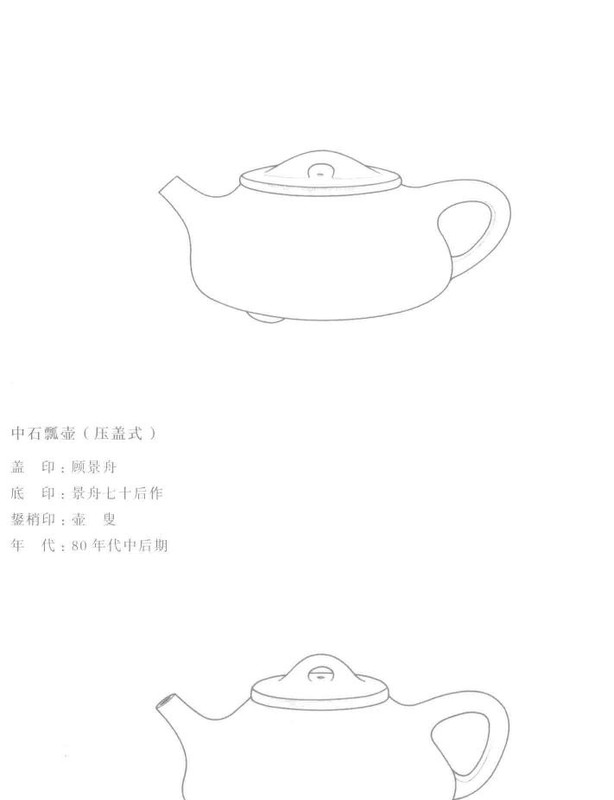
The Zhongshi Piao: Where Classical Geometry Meets Yixing Mastery
When Gu Jingzhou shaped clay in the mid-to-late 1980s, he wasn’t simply making teapots—he was distilling centuries of ceramic philosophy into forms that could fit in your palm. The Zhongshi Piao (中石瓢壶), or “Middle Stone Ladle,” represents one of his most refined interpretations of a classical design that has captivated tea drinkers for generations. This isn’t the flamboyant Dahongpao or the diminutive Xishi; the Zhongshi Piao occupies a deliberate middle ground, both in name and in spirit.
The character “中” (zhong) means “middle” or “center,” and it’s no accident. This teapot embodies balance—not the precarious balance of opposites barely held together, but the settled, confident equilibrium of a design that has found its natural resting point. At 370 milliliters, it’s neither too large for solo contemplation nor too small for sharing tea with a close friend. It’s the Goldilocks of Yixing pottery, and that’s precisely its genius.
The Geometry of Restraint
The Zhongshi Piao belongs to the shidiao (石瓢) family—the “stone ladle” teapots characterized by their geometric precision and architectural sensibility. Unlike naturalistic designs that mimic gourds, fruits, or tree trunks, the stone ladle tradition embraces clean lines and mathematical relationships. Think of it as the Bauhaus movement of Yixing pottery, centuries before Bauhaus existed.
What distinguishes the Zhongshi Piao from its siblings in the stone ladle family is its proportional moderation. The body forms an inverted trapezoid—wider at the shoulder, tapering toward the base—creating what potters call a “robust yet refined” silhouette. This isn’t accidental geometry; it’s functional design. The tapered form provides stability while the broader shoulder maximizes the water’s contact with tea leaves during brewing.
The lines are “smooth and regular,” as period documentation describes, but there’s subtle curvature hidden within that apparent straightness. The base and body display what Chinese potters call mian (面)—curved surfaces so gentle they read as flat until light catches them at certain angles. This is “strength tempered with gentleness,” a quality that sounds poetic but has practical implications. Those subtle curves prevent the harsh visual tension of purely geometric forms while maintaining structural integrity.
Two Interpretations: Pressed Lid vs. Ziye Style
Gu Jingzhou created multiple interpretations of the Zhongshi Piao, and understanding the differences reveals how much variation exists within what might seem like a single design.
The Pressed Lid Style (压盖式)
The pressed lid version, marked with Gu Jingzhou’s seal on the lid and “Hu Zhen” on the handle, represents the more common approach. The lid sits flush with the pot’s rim, creating a seamless visual line when viewed from the side. This “pressed” fitting requires extraordinary precision—the lid must be ground to fit its specific pot, making each piece unique. When you lift the lid, you’ll feel a slight resistance from the air seal, followed by a satisfying release. That’s not just craftsmanship showing off; it’s functional design that keeps your tea hot and prevents dust from entering.
The Ziye Style (子冶式)
The Ziye interpretation takes its name from Chen Yinshao (陈曼生), a Qing Dynasty scholar who styled himself “Ziye.” Chen belonged to that fascinating tradition of Chinese literati who couldn’t resist getting their hands dirty with pottery. Following in the footsteps of Chen Mansheng and Shi Mei, he brought calligraphic and painterly sensibilities to Yixing clay.
The Ziye Zhongshi Piao features distinctive characteristics: a body that tapers more dramatically from top to bottom, a short straight spout, and a triangular handle that creates visual tension. Most notably, it includes three flat feet attached to the base and a bridge-shaped lid knob. This elevated base isn’t mere decoration—it protects surfaces from heat and allows air circulation underneath, helping the pot cool evenly.
The Japanese collector Ao Xuanbao documented a Ziye Zhongshi teapot in his Teapot Chronicle, naming it “One Branch in Hidden Repose.” His description captures the design’s character: “The spout flows downward, ending abruptly as if cut bamboo. The handle is not a complete ring.” He noted carved plum blossom branches on the body and eight characters cast on the lid reading “How many lifetimes of cultivation to attain this”—a Buddhist reference to the rarity of encountering true beauty.
Ao Xuanbao’s observation that “the overall form resembles a small bird” reveals how geometric designs can still evoke natural forms. The triangular handle suggests a wing, the spout a beak, the body a bird at rest. This is the magic of the Ziye interpretation—it maintains geometric discipline while hinting at organic life.
The Clay Speaks
Period examples of the Zhongshi Piao typically use duanni (段泥), a pale yellow clay that fires to colors ranging from cream to light honey. This isn’t the dramatic purple clay (zisha) that many associate with Yixing, but duanni has its own virtues. The clay is denser and less porous than standard zisha, which affects how it seasons and which teas it favors.
The pale color also serves an aesthetic function. Against the light clay, any carved decoration or calligraphy stands out with exceptional clarity. The Ziye versions often featured carved plum blossoms or inscriptions, and the contrast between incised lines and smooth clay surface creates a subtle play of light and shadow.
Master Gu’s Late Period Work
The Zhongshi Piao examples from the mid-to-late 1980s represent Gu Jingzhou’s mature period, when his technical mastery was absolute and his aesthetic judgment refined by decades of practice. By this point, he wasn’t trying to prove anything—he was simply making teapots that embodied his understanding of form, function, and tradition.
The seals tell their own story. “Gu Jingzhou” on the lid, “Made by Jingzhou” (景舟制陶) on the base, and the names of his apprentices or collaborators on the handle—these marks aren’t just signatures but a record of workshop practice. Gu Jingzhou trained numerous students, and the presence of names like “Hu Zhen” and “Suo He” on the handles suggests these pieces involved collaborative work, with the master overseeing and approving the final product.
Tea Pairing: Finding the Right Match
The Zhongshi Piao’s moderate size and duanni clay make it particularly suited to certain tea categories. Understanding these pairings isn’t about rigid rules but about recognizing how clay, form, and tea interact.
Oolong teas are the classic pairing, particularly lighter oxidized varieties like Tieguanyin or high-mountain Taiwanese oolongs. The 370ml capacity is ideal for gongfu brewing—enough volume for multiple infusions without excessive tea waste, small enough to maintain concentration of flavor. The duanni clay’s moderate porosity allows the tea to breathe without over-oxidizing, preserving the delicate floral and fruity notes that define quality oolongs.
Aged white teas also shine in this pot. The geometric form and even heat distribution help coax complexity from aged Shoumei or Gongmei without the aggressive extraction that can occur in more porous clays. The pale clay won’t mask the tea’s color, letting you appreciate the deepening amber hues that aged whites develop.
Raw puerh (sheng cha) works surprisingly well, particularly younger vintages that benefit from the duanni’s gentler approach. The clay tempers puerh’s astringency while allowing its complexity to unfold. However, avoid dedicating a Zhongshi Piao to heavily aged or fermented teas—the clay’s lighter porosity means it will season more slowly and subtly than darker zisha clays.
Green teas can work in a pinch, though the pot’s heat retention makes it less ideal than porcelain or glass. If you do brew green tea, use lower temperatures and shorter steeping times than you might in other vessels.
Brewing Technique: Honoring the Design
Using a Zhongshi Piao effectively means understanding how its design influences the brewing process.
Preheating is essential. The duanni clay’s density means it takes longer to reach optimal temperature. Pour boiling water through the pot and over its exterior before adding tea. This isn’t just warming the vessel—you’re bringing the clay to a temperature where it will maintain heat consistently throughout the brewing session.
The spout’s geometry matters. The Zhongshi Piao typically features a relatively short, straight spout that pours with authority but requires attention. Hold the pot at a moderate angle and pour decisively. The flow should be smooth and controlled, cutting off cleanly when you return the pot to upright. If you pour too tentatively, you’ll get drips.
Lid management is crucial. With the pressed lid style, the tight fit means you need to leave a small gap when pouring to allow air to enter. Otherwise, you’ll create a vacuum that slows the pour to a frustrating trickle. Experienced users develop a feel for exactly how much to tilt the lid—usually just a few millimeters.
The triangular handle on Ziye versions requires a different grip than circular handles. Rather than hooking your finger through, you’ll pinch the handle between thumb and fingers. This provides excellent control but can feel awkward initially. Practice with cool water until the grip becomes natural.
Cleaning and maintenance for duanni requires gentleness. The pale clay shows stains more readily than darker clays, but resist the urge to scrub aggressively. After each session, rinse thoroughly with hot water and let the pot air dry completely with the lid off. The clay will gradually develop a subtle patina, but it should remain relatively light. If you notice dark staining, you’re likely using too much tea or not rinsing thoroughly enough.
The Middle Way in Practice
What makes the Zhongshi Piao enduringly relevant isn’t innovation but perfection of proportion. In a world of teapots that shout for attention with elaborate decoration or extreme forms, the Zhongshi Piao speaks quietly. It’s the pot you reach for when you want the tea to be the star, when you’re brewing for someone whose opinion you respect, when you want to demonstrate that you understand the difference between complexity and complication.
The “middle” in its name isn’t compromise—it’s synthesis. The pot balances geometric precision with subtle organic curves, classical restraint with functional intelligence, individual expression with traditional form. When Gu Jingzhou shaped these pots in the 1980s, he was working within a design language centuries old, yet each piece bears his distinctive touch.
For the tea drinker, the Zhongshi Piao offers something increasingly rare: a vessel that doesn’t demand attention but rewards it. Use it daily, and you’ll notice how the spout’s angle affects the pour, how the clay’s warmth feels in your hand, how the proportions create a sense of rightness that’s hard to articulate but impossible to miss.
This is pottery as philosophy made tangible—the idea that the middle way, properly understood, isn’t bland moderation but dynamic balance. The Zhongshi Piao doesn’t sit between extremes; it transcends them, creating something that feels both inevitable and surprising, traditional and fresh, simple and profound.
In your hands, it’s just a teapot. But it’s a teapot that knows exactly what it is and does it with quiet confidence. That’s worth celebrating.
