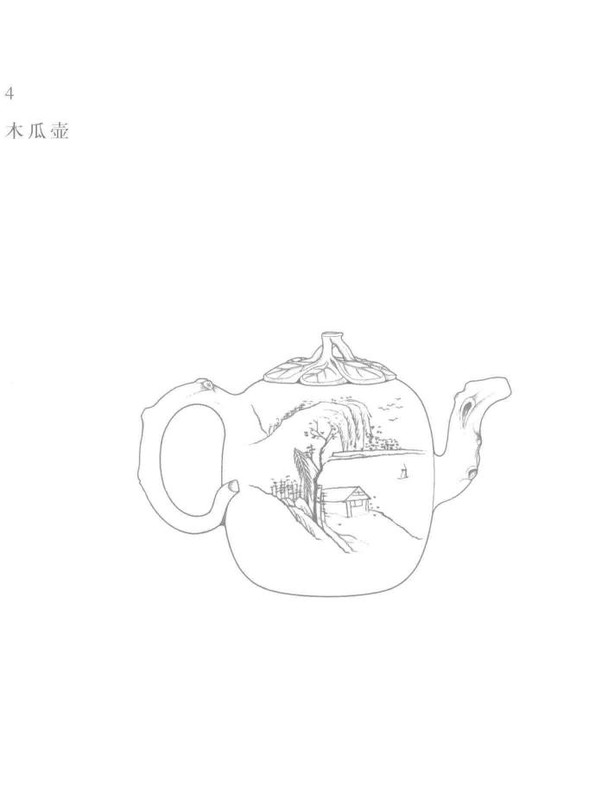
木瓜壶
Transformation of Spirit In traditional Chinese culture, the wood apple (*mugua*) is considered an auspicious object. The motif derives from the *B
The Mugua Hu (木瓜壶): A Celebration of Gratitude in Clay
When you hold a Mugua Hu—the Wood Apple Teapot—you’re cradling more than just a vessel for brewing tea. You’re holding a three-dimensional poem, a sculptural reminder of one of Chinese culture’s most cherished values: the reciprocity of kindness. This distinctive Yixing design transforms the humble wood apple fruit into an elegant meditation on gratitude, and in doing so, creates one of the most beloved teapot forms of the Republican era.
The Poetry Behind the Form
The Mugua Hu draws its inspiration from a verse in the Shijing (Book of Songs), China’s oldest collection of poetry: “You cast me a wood apple, and I repay you with jade.” This ancient metaphor speaks to the principle of yongquan xiangbao—when someone offers you a drop of water in need, you should repay them with a flowing spring. The wood apple (mugua) itself became an auspicious symbol in Chinese culture, representing not just gratitude but the deeper wisdom of remembering one’s sources and honoring those who have helped us along our path.
This philosophical foundation elevates the Mugua Hu beyond mere functionality. Every time you brew tea in this pot, you’re participating in a ritual that acknowledges interconnection and debt—drinking water while remembering its source, as the saying goes.
A Design That Captures Nature’s Architecture
The Mugua Hu is a masterclass in biomimetic design, centuries before that term entered our vocabulary. The teapot’s body takes the form of the wood apple fruit itself—that distinctive ribbed, slightly elongated shape that makes the mugua instantly recognizable. The melon becomes the body, the calyx (the leafy crown where the fruit connects to the plant) becomes the lid, and the vine transforms into both the spout and handle.
What makes this design so successful is its ingenious proportioning. The measurements aren’t arbitrary—they’re carefully calibrated to capture the essence of the fruit while maintaining the practical requirements of a functional teapot. The ribbed sections of the body create visual interest and provide subtle texture that feels natural in the hand, while the organic curves ensure the pot pours smoothly and sits stably.
The spout typically curves in a gnarled, branch-like form, often with a bent joint that mimics the way actual vines grow—not in perfect straight lines, but with the character and irregularity of living plants. Branches and leaves climb over the handle and lid, with leaf veins and textures skillfully rendered to create depth and naturalism. The artisan’s skill shows in these details: the leaves aren’t merely stamped or molded, but carefully dotted and arranged to emanate what collectors describe as a “quiet and subtle natural beauty.”
Interestingly, many Mugua Hu designs exercise restraint in their decoration. Often, only a single leaf is attached to the body of the teapot—simple yet vivid. This minimalism prevents the design from becoming cluttered or overly busy, allowing the fundamental form of the wood apple to remain the star of the composition.
The Republican Era Golden Age
The Mugua Hu reached its peak popularity during the Republican period (1912-1949), particularly in the 1930s and 1940s. This was a fascinating time for Yixing pottery—a period when traditional craftsmanship met new aesthetic sensibilities, when ancient forms were being reinterpreted by master artisans who had trained in the old ways but were creating for a changing China.
A particularly notable example from this era bears the maker’s seal “Jingji” (景济) and the studio mark “Ziyixuan” (自怡轩) on its base. Dating to the 1930s-40s, this piece represents the Mugua Hu at its refined best. The Ziyixuan studio name translates roughly to “Pavilion of Self-Contentment,” suggesting a workshop philosophy centered on personal satisfaction and artistic integrity rather than mass production—an important distinction during a period when Yixing pottery was becoming increasingly commercialized.
Gu Jingzhou’s Masterful Interpretation
No discussion of the Mugua Hu would be complete without examining the contributions of Gu Jingzhou (顾景舟, 1915-1996), widely considered one of the greatest Yixing masters of the 20th century. Gu’s interpretation of the Wood Apple Teapot demonstrates how a master artisan can take a traditional form and elevate it to new heights.
Gu Jingzhou’s Mugua Hu features a body structure that’s slightly taller than works by his predecessors. This seemingly small adjustment has profound effects on the pot’s character—it makes the form more upright, more elegant, more refined. The proportions shift from rustic charm toward sophisticated grace, yet the design remains “soft with an underlying strength,” as period descriptions note.
His spout design is particularly noteworthy: bent into a gnarled joint shape with rational composition, it manages to look both organic and purposeful. This is the mark of a master—creating something that appears natural and effortless while being carefully calculated for optimal pouring performance.
The way Gu handled the decorative elements shows similar sophistication. Branches and leaves climb over the handle and lid, but they’re arranged with such skill that they enhance rather than overwhelm the form. The leaf veins and textures are “skillfully dotted and arranged,” creating visual interest without fussiness. His characteristic restraint—often using just a single leaf on the body—demonstrates the confidence of an artisan who knows that less can indeed be more.
The Clay and Its Character
Traditional Mugua Hu are typically crafted from Yixing’s famous zisha (purple clay), though the specific clay body can vary. Many examples use zhuni (vermillion clay) or hongni (red clay), which complement the warm, earthy associations of the wood apple fruit. These clays have the porous quality that makes Yixing teapots prized—they absorb trace amounts of tea oils over time, gradually seasoning the pot and enhancing the flavor of subsequent brews.
The clay choice affects more than just color. Zhuni, for instance, has a higher firing temperature and creates a denser, more resonant body that some tea enthusiasts prefer for certain tea types. The slightly grainy texture of well-prepared zisha clay also contributes to the naturalistic aesthetic—it doesn’t look like glazed porcelain trying to imitate a fruit, but rather like earth itself shaped into organic form.
Tea Pairing: Finding the Right Match
The Mugua Hu’s design characteristics make it particularly well-suited for certain types of tea. The moderate size of most examples (typically 150-250ml capacity) makes them ideal for solo brewing or intimate tea sessions with one or two companions. The rounded body with its ribbed sections provides good heat retention while allowing for adequate expansion of tea leaves.
Oolong teas are perhaps the most natural pairing for a Mugua Hu. The pot’s shape and clay composition work beautifully with medium to heavily oxidized oolongs—think traditional Wuyi rock teas like Da Hong Pao or Shui Xian, or Taiwanese high-mountain oolongs. The rounded body allows rolled oolong leaves to unfurl completely, while the clay’s porosity helps soften any harsh edges in the tea’s flavor profile.
Aged white teas also shine in a Mugua Hu. The gentle curves and organic form seem to complement the mellow, nuanced character of well-aged Shou Mei or Gong Mei. The pot’s heat retention helps coax out the subtle complexities that develop in white tea over years of careful storage.
Red teas (what the West calls black tea), particularly Yunnan Dian Hong or Fujian Zhengshan Xiaozhong, find a welcoming home in this pot. The clay’s natural sweetness enhances the malty, honeyed notes in these teas, while the pot’s shape provides the heat needed to fully extract their rich flavors.
What you’ll want to avoid are delicate green teas or very light oolongs. The Mugua Hu’s heat retention and clay composition can overwhelm subtle flavors, and these teas generally prefer porcelain or glass vessels that won’t interfere with their fresh, vegetal character.
Brewing Technique and Care
Using a Mugua Hu properly requires understanding both its capabilities and its quirks. The curved spout, while beautiful, means you need to pay attention to your pouring angle. The gnarled, branch-like design can sometimes create a slightly slower pour than a straight spout, so adjust your technique accordingly—tip the pot decisively rather than tentatively.
Before first use, give your Mugua Hu a proper initiation. Rinse it thoroughly with hot water, then brew several pots of the tea type you plan to dedicate it to, discarding these initial brews. This begins the seasoning process and removes any clay dust from manufacturing.
Many Yixing enthusiasts dedicate each pot to a single tea type, allowing the clay to absorb and enhance that specific tea’s character over time. With a Mugua Hu, this practice is particularly rewarding—over months and years, the pot develops a patina and a “memory” that can actually improve your tea’s flavor.
After each use, rinse the pot with hot water only—no soap, which can be absorbed by the porous clay and taint future brews. Leave the lid off to allow the pot to dry completely between uses. Some collectors gently wipe the exterior with a soft tea cloth while the pot is still warm, gradually building up a lustrous sheen.
The ribbed body of the Mugua Hu requires special attention during cleaning. Tea leaves can occasionally lodge in the crevices between ribs, so use a soft brush to gently clean these areas. The decorative leaves and vine details also need careful handling—they’re more delicate than the main body and can be damaged by rough treatment.
The Collector’s Perspective
For collectors, the Mugua Hu represents an interesting intersection of artistic merit and cultural significance. Examples from the Republican era, particularly those by known makers or from established studios, have become increasingly sought after. The presence of clear maker’s marks (like the “Jingji” seal) or studio stamps (like “Ziyixuan”) significantly affects value and authenticity verification.
Gu Jingzhou’s Mugua Hu pieces are particularly prized, commanding premium prices at auction. His refinement of the form—that slightly taller, more elegant proportion—is now considered by many to be the definitive interpretation of the design. However, earlier examples from the 1930s-40s have their own appeal, often displaying a more rustic, immediate charm that speaks to the form’s folk art origins.
When evaluating a Mugua Hu, look for harmony in the proportions—the relationship between body, spout, handle, and lid should feel balanced and natural. The decorative elements should enhance rather than distract from the overall form. The clay should be well-prepared and evenly fired, with no cracks or imperfections. And perhaps most importantly, the pot should feel right in your hand—comfortable to hold, easy to pour, satisfying to use.
Living Philosophy in Clay
What ultimately makes the Mugua Hu special isn’t just its aesthetic appeal or its functional excellence—it’s the way it embodies a philosophy of gratitude and reciprocity. In our modern world of disposable goods and transactional relationships, there’s something deeply meaningful about brewing tea in a vessel that literally takes the shape of an ancient symbol for remembering kindness.
Each time you pour tea from a Wood Apple Teapot, you’re participating in a tradition that stretches back centuries, connecting you to the anonymous poet who first wrote about exchanging wood apples for jade, to the Republican-era artisans who perfected the form, to masters like Gu Jingzhou who elevated it to high art, and to countless tea drinkers who have found in this humble fruit-shaped pot a reminder to drink water while remembering its source.
The Mugua Hu teaches us that the best designs aren’t just beautiful—they’re meaningful. They carry stories, embody values, and enrich our daily rituals with layers of significance that transcend mere utility. In the quiet moment of brewing tea, in the gentle curve of a vine-shaped handle, in the simple presence of a single clay leaf, we find an invitation to remember: gratitude is not just a feeling but a practice, not just a thought but a way of being in the world.
And that, perhaps, is the greatest gift this wood apple teapot offers—not just better tea, but a better way of drinking it.
