虚扁壶
Discover the 虚扁壶, a classic Yixing pottery design with unique characteristics
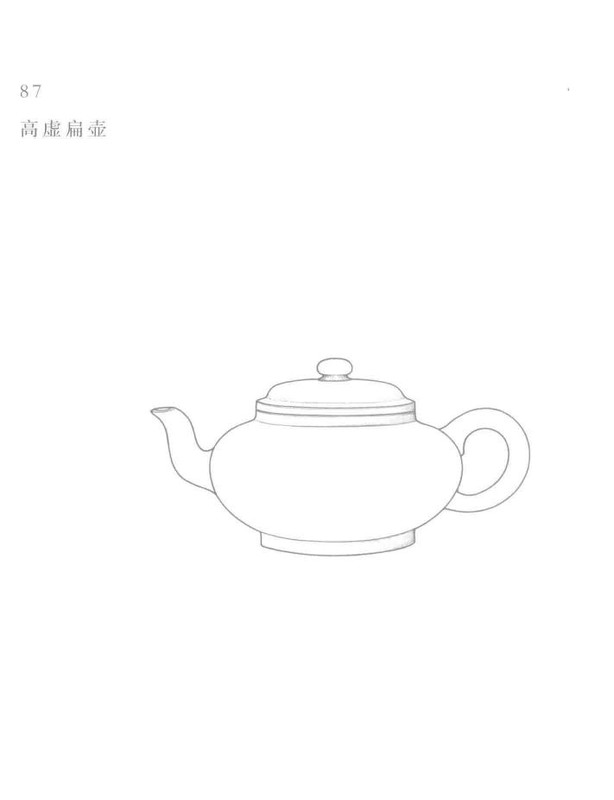
The Xu Bian Hu (虚扁壶): A Masterwork of Restraint and Balance
In the pantheon of classical Yixing teapot designs, few forms embody the principle of “less is more” quite like the Xu Bian Hu—literally translated as the “Void Flat Pot” or “Empty Flat Pot.” This name itself is a meditation on space and form, suggesting a vessel that achieves fullness through emptiness, substance through restraint. Among collectors and connoisseurs, the Xu Bian Hu represents one of the most challenging shapes to execute properly, demanding absolute precision in its deceptively simple geometry.
The Philosophy Behind the Form
The character 虚 (xu) carries profound meaning in Chinese aesthetics—it speaks to void, emptiness, and the negative space that gives positive form its power. When master potter Gu Jingzhou created his interpretation of this classic design in the early 1990s, he was working within a tradition that valued restraint as the highest form of sophistication. The flattened, disc-like body of the Xu Bian Hu creates a visual tension between horizontal expansion and vertical compression, resulting in a form that appears to hover between two and three dimensions.
This is not a teapot that announces itself with elaborate decoration or dramatic curves. Instead, it whispers its excellence through proportion, balance, and the subtle interplay of convex and concave surfaces. The “flatness” referenced in its name is not mere description but aesthetic intention—a deliberate choice to explore how minimal height can create maximal presence.
Gu Jingzhou’s Legacy in Clay
The example documented in the early 1990s bears the seals and marks of Gu Jingzhou (顾景舟), born in the year of Yimao and widely regarded as the most influential Yixing potter of the 20th century. His base seal reading “景舟制包” (Made by Jingzhou Bao) and the lid seal simply stating “景舟” (Jingzhou) authenticate this piece as coming from the master’s own hands during the final creative period of his life.
Gu Jingzhou’s approach to the Xu Bian Hu exemplifies his broader philosophy: that classical forms should be preserved not through rigid copying but through deep understanding and subtle refinement. By the 1990s, Gu had spent over six decades perfecting his craft, and his late-period works show a confidence that allows for the slightest adjustments—a millimeter here, a degree of curve there—that transform a good pot into an exceptional one.
The inscription “陶壶外史” (Unofficial History of Ceramic Teapots) found on this piece adds another layer of meaning. It positions the pot not just as a functional object but as a chapter in the ongoing story of Chinese ceramic art, a physical manifestation of centuries of accumulated knowledge and aesthetic evolution.
Anatomy of Restraint: Design Elements
The Body
The defining characteristic of the Xu Bian Hu is its dramatically flattened body—imagine a sphere compressed from top and bottom until it becomes a thick disc. This creates a wide, stable base with a low center of gravity, giving the pot an almost architectural presence despite its modest height. The body typically features a gentle outward curve at its widest point, creating what potters call a “shoulder” that provides visual interest without disrupting the overall horizontal emphasis.
The clay used in traditional Xu Bian Hu designs is often zisha (purple clay) in its various natural tones—from warm reddish-browns to cooler grey-purples. The flat form actually showcases the clay’s natural texture and color more effectively than taller shapes, as light plays across the broad surfaces differently throughout the day, revealing subtle variations in the clay body.
The Spout and Handle
On a Xu Bian Hu, the spout (referred to in the documentation as “索鼻” or “spout nose”) must be carefully proportioned to maintain the pot’s horizontal emphasis. It typically extends outward in a gentle, slightly downward curve—not too high, which would contradict the flat aesthetic, and not too low, which would make pouring awkward. The spout’s placement and angle are critical: it must pour cleanly without dribbling, yet remain visually subordinate to the body’s dominant horizontal line.
The handle forms a complementary arc, rising just high enough to allow comfortable grip while echoing the body’s compressed geometry. In Gu Jingzhou’s interpretation, the handle would have been shaped with ergonomic precision—comfortable for hands of various sizes, balanced to prevent the pot from tipping when lifted full, and aesthetically harmonious with the overall form.
The Lid
The lid of a Xu Bian Hu is perhaps its most technically demanding element. It must fit with absolute precision—tight enough to create a proper seal for brewing, yet easy enough to remove without struggle. The lid typically features a low, flattened profile that continues the body’s horizontal theme, often with a small knob or button finial that provides just enough purchase for fingers without disrupting the visual flow.
The fit between lid and body is one way to judge a Xu Bian Hu’s quality. When you lift a well-made example by its lid knob, the entire pot should rise with it, held by air pressure alone. When you cover the air hole and pour, the flow should stop immediately. These aren’t just party tricks—they demonstrate the precision that separates masterworks from mere competent pottery.
The Challenge of Simplicity
Potters often say that the Xu Bian Hu is one of the most difficult classical forms to execute successfully precisely because it offers nowhere to hide. An ornate pot can disguise slight asymmetries or proportion issues with decorative elements; a tall, complex form can distract the eye from minor flaws. The Xu Bian Hu offers no such mercy.
Every line must be true. Every curve must flow naturally. The slightest wobble in the body’s profile becomes immediately apparent. The lid must sit perfectly level, or the entire pot looks askew. The spout and handle must be positioned with mathematical precision, or the visual balance collapses. This is why authentic Xu Bian Hu pots by master potters command such respect—they represent not just skill but the confidence to work without artifice.
Tea Pairing: Finding the Right Match
The Xu Bian Hu’s unique form influences how it interacts with tea, making it particularly suited to certain varieties while less ideal for others.
Ideal Teas
Aged Oolong: The pot’s broad, flat body provides excellent surface area for heat distribution, making it superb for aged oolongs that benefit from steady, even temperature. The wide form allows the leaves to unfurl completely, and the relatively large capacity (most Xu Bian Hu hold 200-300ml) accommodates the generous leaf-to-water ratios these teas often require.
Ripe Pu-erh (Shou): The thick walls typical of Xu Bian Hu designs retain heat well, which is essential for coaxing the deep, earthy flavors from ripe pu-erh. The wide body also helps manage the sometimes-muddy texture of lower-grade shou, allowing sediment to settle while you pour.
Aged White Tea: The gentle, even heat distribution of the flat form treats delicate aged white teas with respect, extracting their subtle complexity without the harsh edges that can come from pots with more concentrated heat zones.
Less Ideal Matches
Green Tea: The heat retention that benefits aged teas can be too much for delicate green teas, which prefer cooler water and shorter steeping times. The Xu Bian Hu’s thermal mass works against the quick, light touch green tea demands.
High-Fired Oolong: Tightly rolled, high-fired oolongs like traditional Tieguanyin benefit from taller pots where the leaves have vertical space to expand. The Xu Bian Hu’s compressed form can feel constraining for these teas.
Brewing Technique: Working with the Form
Using a Xu Bian Hu effectively requires understanding how its unique shape affects the brewing process.
Preheating
The flat, wide body means more surface area exposed to air, which can lead to faster heat loss. Preheat thoroughly by filling with boiling water and letting it sit for at least a minute before discarding and adding your tea. Some practitioners preheat twice for particularly heat-sensitive teas.
Leaf Quantity
The wide, shallow interior means leaves spread out more than they would in a taller pot. You may need to adjust your usual leaf-to-water ratio slightly upward—perhaps 10-15% more leaf than you’d use in a taller pot of the same capacity. The leaves should cover the bottom in a loose layer, not pile up in the center.
Pouring Technique
The low profile and wide body mean the water has less distance to fall when you pour, which can be an advantage for delicate teas. Pour in a circular motion to ensure even saturation of the leaves. The spout’s typically gentle angle means you’ll need to tip the pot more decisively than with steeper-spouted designs—commit to the pour rather than hesitating.
Temperature Management
Between infusions, keep the lid slightly ajar rather than fully removed. The wide opening means heat escapes quickly when fully open, but a small gap allows steam to vent while maintaining more consistent temperature. This is particularly important for teas that benefit from sustained heat between steeps.
Collecting and Authentication
Given Gu Jingzhou’s stature and the technical difficulty of the Xu Bian Hu form, authentic examples—particularly those from his late period in the early 1990s—are highly sought after and frequently reproduced. Several factors help authenticate genuine pieces:
Seal Quality: Gu’s seals were carved with precision and applied with consistent pressure. The characters should be crisp and clear, with no blurred edges or incomplete impressions. The documented seals “景舟” and “景舟制包” should match known examples from this period.
Clay Quality: Genuine Yixing zisha has a distinctive texture and appearance that’s difficult to fake convincingly. The clay should feel slightly grainy but not rough, with a natural luster that develops with use rather than an artificial shine.
Proportional Precision: Measure carefully. In a true master’s work, the relationships between height, width, spout length, and handle height follow mathematical principles that create visual harmony. Reproductions often get these ratios slightly wrong.
Weight and Balance: A well-made Xu Bian Hu should feel substantial but not heavy, with perfect balance when held by the handle. The center of gravity should be low and stable.
The Xu Bian Hu in Contemporary Practice
While the Xu Bian Hu is a classical form with centuries of history, it remains relevant to contemporary tea practice. Its aesthetic of restraint appeals to modern sensibilities that value minimalism and essential form. The technical challenge it presents continues to attract serious potters who want to test their skills against one of the tradition’s most demanding shapes.
For tea drinkers, the Xu Bian Hu offers a different experience from more common teapot forms. Its low, wide profile creates a more intimate relationship with the tea—you’re looking down into the leaves rather than peering into a tall vessel. The broad surface area means you can observe the leaves’ transformation more easily, watching them unfurl and dance in the water.
Conclusion: The Power of Emptiness
The Xu Bian Hu reminds us that in tea, as in life, sometimes the most profound statements come through restraint rather than elaboration. Its flattened form, which might seem like a limitation, becomes a source of strength—a demonstration that beauty doesn’t require height or complexity, only proportion, balance, and honest craftsmanship.
When Gu Jingzhou shaped his Xu Bian Hu in the early 1990s, he was working at the end of a long life dedicated to understanding clay and form. The pot that resulted—marked with his seals, shaped by his experienced hands—represents not just a functional object but a philosophy made tangible: that emptiness can be full, that flatness can have depth, and that the simplest forms often require the greatest mastery.
For those fortunate enough to brew tea in an authentic Xu Bian Hu, each session becomes a meditation on these principles. The pot asks you to slow down, to appreciate subtlety, to find richness in restraint. In our age of excess and elaboration, perhaps that’s the most valuable lesson this humble, flattened vessel has to teach.
